




Todmorden Town Hall
Todmorden was built on the success of its machine looms during the early industrial revolution, powered by the fast flowing streams running from the steep hills that surround the Upper Calder Valley.
The Fielden family were the town’s first cotton magnates. They funded the construction of its most significant buildings, commissioning the notable architect John Gibson to design them. These included Dobroyd Castle (grade II*), The Unitarian Church (grade I), and the Town Hall. Gibson had worked with Charles Barry on the Palace of Westminster (grade I) and was also responsible for Gibson Hall in London (grade I) and St Margarets in Bodelwyddan (grade II*).
Todmorden Town Hall is listed grade I and was constructed between 1866-1875 in the Greek Revival style. Originally an administrative and civic centre, the hall straddles a stream that marked the border between Yorkshire and Lancashire. It boasts a series of impressive civic spaces and innovative features such as the distinctively decorated ceiling cowls that draw air from the main hall and through the roof space to ventilate the building.
The hall is a focal point for the active local community. It is used variously as a council chamber, a venue for concerts, plays and weddings, a base for interest groups, a conference centre and a meeting space. However, access is convoluted and its spaces are poorly supported by illogically positioned ancillary facilities. The building was failing to serve its patrons well and had consequently become underused.
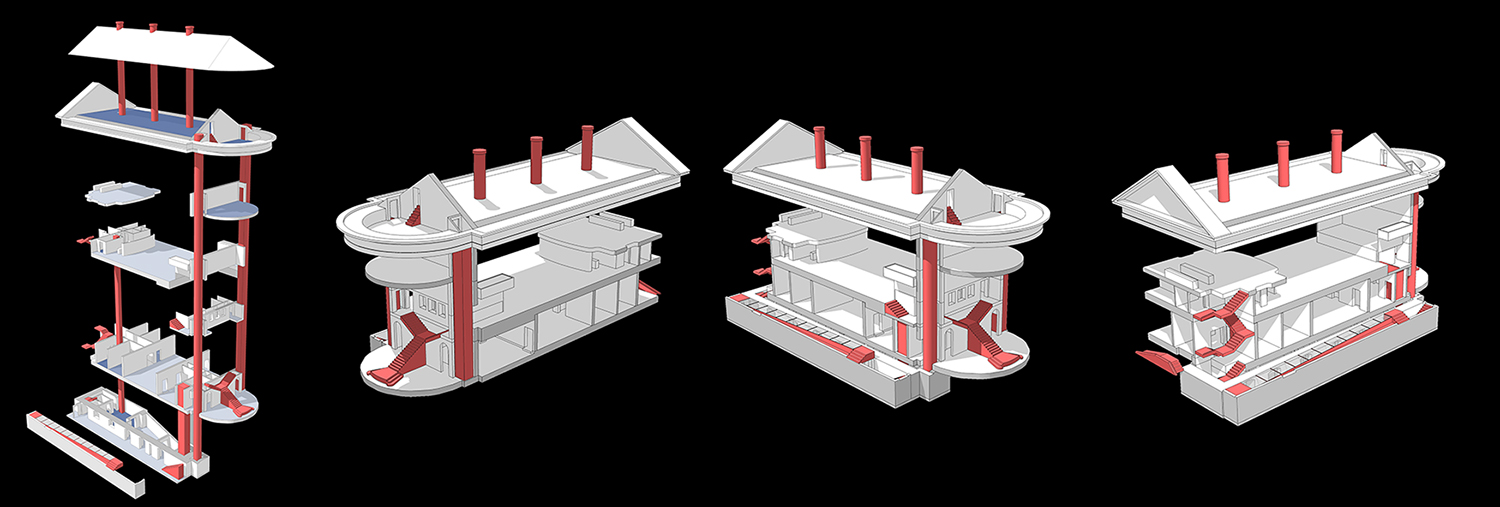
A national competition invited practices to devise schemes to unlock its potential. Our entry focused on untangling the complex horizontal and vertical circulation paths and providing distinct routes for each of the three main user groups, whose needs were often opposing. Each gained an independent and accessible front door. A new glass ramp doubled as a roof covering for a new basement cafe, which was included to broaden the facilities available, generate additional revenue and enliven the frontage throughout the day.
Graham developed the proposals whilst working at Hopper Howe Sadler. The scheme was shortlisted with two other firms.